Showing posts with label Equality. Show all posts

Monday, 9 March 2015

Right to Strike puts conservatives on notice


"Saskatchewan's Labour Movement: the folks who brought you the constitutional right to strike!” said Saskatchewan Federation of Labour (SFL) president, Larry Hubich, as the Supreme Court of Canada (SCC) sided with working families on January 30, 2015.
The SCC ruled, in no uncertain terms, that the SFL was right – the Saskatchewan Party government’s Public Services Essential Services Act (Bill 5) was heavy-handed, unworkable, and violated a Charter-protected right to strike.
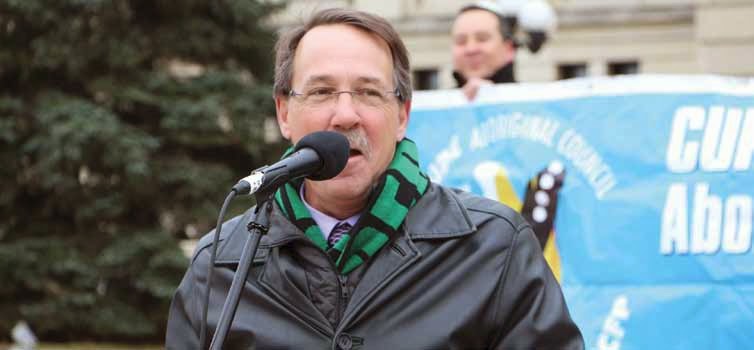
“The decision by the Supreme Court to grant every worker in Canada a constitutional right to strike is a profound victory for our movement,” said Hubich, “the Court also delivered a strong message to conservative governments everywhere: your rigid ideology does not trump workers’ rights,” he added.
The Public Services Essential Services Act (Bill 5) was introduced by the newly-elected Saskatchewan Party government in 2007. As soon as it was introduced, workers, their unions, lawyers, and academics all said the Bill was overreaching, unnecessary, and probably illegal. The Saskatchewan Party, though, continued to only listen to their corporate friends instead of Saskatchewan families. As a result, a long Charter Challenge was launched by the SFL and its affiliates against Bill 5 to protect working families.
Despite the long and expensive court process, workers and their unions were gracious in their victory – extending an invitation to the Saskatchewan Party government to work together.
“We know that a work stoppage is always the last resort, and unions always prefer a negotiated agreement that is good for both sides,” said Hubich, “our victory does not change any of that, and we want to work with the provincial government to develop labour laws that are fair, balanced, and respect the rights of workers,” he added.
However, just a few days after the SCC ruling, Brad Wall floated the option of using the notwithstanding clause so that he and his government could continue violating Charter rights.
“This is a time for reconciliation and leadership, not a time for the premier to stomp his feet and threaten to deny Saskatchewan families their Charter rights,” said Hubich, “workers and their unions continue to offer our cooperation to create good public policy, and we hope the premier will come to the table in good faith,” he added.

Thursday, 3 January 2013

PayWatch: The Clash for Cash


Overcompensated: CEO Pay Rates Show Growing Inequality in Canada


By 1:18pm on January 2, the first official working day of the year, Canada’s top 100 CEOs will have already pocketed $45,448 - the income that it takes the average Canadian an entire year of full-time work to earn.

The Canadian Centre for Policy Alternatives has produced a fact sheet, Overcompensating: Executive Pay in Canada, highlights some key numbers around executive pay in Canada and also includes a list of Canada's highest paid 100 CEOs.
http://www.policyalternatives.ca/publications/commentary/overcompensating

You can also visit their pay clock, The Clash for the Cash: CEO vs. Average Joe, to find out just how much the average worker and top CEO have earned so far.
http://policyalternatives.ca/ceo/

Monday, 5 September 2011

Saskatchewan People Set to Celebrate Labour Day - 2011

News Release
FOR IMMEDIATE RELEASE

Saskatchewan People Set to Celebrate Labour Day

On Monday, September 5th, people across Saskatchewan, of many backgrounds and traditions, spanning several generations, and representing a variety of occupations and professions, will gather together to celebrate Labour Day. Originally a day to commemorate the struggle of working people to reduce the workday to eight hours, Labour Day is an important opportunity not only to celebrate, but also to renew commitments to improving people’s quality of life.

“Labour Day is an extremely important day,” said Larry Hubich, President of the Saskatchewan Federation of Labour, “not only for the women and men that work in Saskatchewan and across the country, but for all people who now benefit from the efforts of working people. Working people from Saskatchewan have been instrumental in creating many of the things in our society that all people hold dear today: Medicare, pensions, quality education, and laws regarding health and safety, just to name a few.”

First observed as a Canadian national holiday in 1894, Labour Day is now observed in a number of countries across the globe every year. Celebrations typically include barbeques, picnics, and parades, complete with singing, storytelling, and speeches from community leaders.

“As important as it is to celebrate what we have achieved as working people and as a society, it is also important to view Labour Day as an opportunity to renew our commitment to improving the quality of life for the people of the province. We believe that it is always possible to improve upon what we’ve already achieved in our province, and Labour Day is an opportunity to recommit to making those improvements. As the economic gap between the rich and the poor continues to grow, it will be increasingly important for us to strive to improve upon the things that make Saskatchewan a great place to live, work, and raise a family.”

- 30 -

The SFL represents over 98,000 unionized workers across the province in 37 affiliated unions.

Tuesday, 26 April 2011

Stand Up for our Human Rights - SFL Labour Reporter

The following is the lead article from the May 2011 issue of the SFL Labour Reporter - the issue is dedicated to the protection of Human Rights, in Saskatchewan, Canada and abroad. 

You can download the complete issue here...

Stand up for our human rights

The provincial government’s attempts to roll back human rights are steadily mounting.

Among the first official acts of the current government, upon taking office in 2007, was to strip working people across the province of their freedom to associate and to express themselves as union members.

The “essential services” legislation has robbed tens of thousands of Saskatchewan people of their right to assemble, to raise awareness of their concerns, and to strike.

The Trade Union Act was simultaneously weakened, making it much more difficult for people to band together and to negotiate collectively with their employers.

Last year, the International Labour Organization ruled that these laws violate workers’ freedoms under international law, but the government refuses to comply with the United Nations ruling.

Inside you will read about the government’s attempt to amend the Marriage Act, to legalize discrimination against same-sex couples.

The unanimous Saskatchewan Court of Appeal decision on the duty of marriage commissioners to marry same-sex, inter-racial and inter-faith couples in our province is a human rights victory for Saskatchewan citizens.

Now the government has introduced Bill 160, which if made law, will seriously weaken the Human Rights Code.

I invite you to read selections from a very important address given by Alex Neve, Secretary General of Amnesty International Canada.

He sounds the alarm on several aspects of Bill 160, including the abolishment of our human rights tribunal and changes that will make complaints much more likely to be dismissed by the chief commissioner.

Governments are supposed to promote human rights, not lessen them. As you’ll see on p. 7, the Harper government has an equally offensive record on human rights. I encourage you all to vote for human rights and for open and transparent government on election day.

And I look forward to seeing you all at Movement for May Day on May 1 (p.8), where together we’ll tell our elected officials it’s time to respect our human rights!

In Solidarity,
Larry Hubich

Thursday, 24 March 2011

The "Other Saskatchewan" - CCPA

Reproduced below is a 2011 Saskatchewan Budget Response by Dr. Simon Enoch, CCPA Saskatchewan:

The “Other Saskatchewan”

A Budget Response by CCPA Saskatchewan

by Simon Enoch

March 24, 2011

If yesterday’s budget was designed to give something to everyone in order to win over voters for the upcoming election, then it is clear where the poorest and most vulnerable in our province rank in the minds of Sask Party electoral strategists.

Despite an obvious and acute housing crisis, this budget offered a paltry $1.7 million for two new affordable housing initiatives while the immediate need for new housing in the province is approximately 3000 units. For those who cannot wait for the construction of new housing, no relief was forthcoming to prevent the regular rent increases that seem to have become the norm in our province.

Despite ranking dead last among the provinces in child-care space, the budget offered to fund the creation of only 500 new child-care spaces when the need is closer to 5000. Currently, Saskatchewan has licensed child-care spots for only 9.1 per cent of children between the ages of zero and five, compared to the 20.3 per cent national average. While we applaud the government for committing to the creation of these new spaces, our province desperately needs a much more aggressive and long-term policy to address our child-care needs.

Despite the desperate need to replace the only psychiatric hospital in the province, this budget offered absolutely nothing for those suffering from mental illness.

In contrast, business owners will reap almost $80 million in tax savings due to the reduction of the small business tax while off-sale beer vendors will enjoy a $5.1 million discount. While the government has made much of it’s low-income tax reduction policy, a tax cut on nothing is still nothing. If we were to measure what constituencies this government covets by the amount of largesse given to them in yesterday’s budget, it is obvious where the poorest in our province rank.

Finance Minister Ken Krawetz stressed that this budget represented the “New Saskatchewan” and that we are no longer “next year country” but “this year country.” Perhaps a better metaphor for the province could be borrowed from the famous American political commentator Michael Harrington; “The Other Saskatchewan.” The “Other Saskatchewan” has not shared in the prosperity that the Sask Party is so quick to claim credit for. The “Other Saskatchewan” includes people who cannot afford spiraling rent increases, food and fuel prices, utility bills and other basic necessities. The “Other Saskatchewan” is experiencing increased homelessness, growing social assistance caseloads, lack of access to quality childcare, increasing unemployment among aboriginal peoples and a woefully inadequate minimum wage.

Finance Minister Ken Krawetz also made repeated mention of the “Saskatchewan Advantage” – obviously borrowing from the oft-used “Alberta Advantage.” Let’s hope that the Sask Party is not intent on also borrowing Alberta’s record of wanton neglect for the poorest in that province as well; the “Other Saskatchewan” simply cannot afford it.

Friday, 11 March 2011

Labour Rights Human Rights - What's happening in Saskatchewan


Check out the Saskatchewan Federation of Labour's newest edition of the booklet:


(Click on the image to download a copy)

Potash Corp's new numbers - Erin Weir Progressive Economics Forum

Potash Corp’s Fuzzy Math

March 10th, 2011

In a couple of recent posts, I threw down the gauntlet for PotashCorp to disclose how much corporate income tax and Crown royalties it paid to the Government of Saskatchewan.

As Bruce Johnstone reports, it has finally done so:

"While PotashCorp paid $77 million in resource surcharges in 2010, it also paid $82 million in corporate income taxes and $70 million in Crown royalties. In total, PotashCorp paid about $230 million in royalties and taxes to the province in 2010."

So, I was correct in suggesting that it paid less corporate income tax to Saskatchewan than to Trinidad ($82 million versus $113 million). PotashCorp paid Trinidadian tax on a manufacturing facility, not for extracting the island’s natural resources.

That is the fundamental difference between corporate income taxes and resource royalties. All industries are subject to corporate tax. Royalties are separate fees for the extraction of publicly-owned natural resources.

It is inappropriate to add up PotashCorp’s puny corporate tax payment and puny royalty payments to produce a seemingly respectable total. It is appropriate to combine the resource surcharge with Crown royalties for total resource royalties of $147 million in 2010.

That year, the company sold $2.8 billion of Saskatchewan potash. (It sold $3 billion in total, but 8% of its potash production was from New Brunswick.)

The surcharge is set at 3% of potash sales and Crown royalties range from 2.1% to 4.5% of potash produced from Crown lands. The $147-million total amounts to 5% of $2.8 billion – a nickel for every dollar of potash sold.

PotashCorp’s fourth-quarter reports compare royalties to potash gross margin, upon which the Potash Production Tax (that it did not pay in 2010) is based. The company generated a gross margin of $1.6 billion from Saskatchewan potash in 2010 ($1.8 billion minus New Brunswick). So, it paid a whopping nine cents per dollar of potash gross margin.

PotashCorp is now trying to argue that the appropriate base of comparison is neither sales nor gross margin but earnings: “If you just take a look at our net earnings after tax, yes, it was $1.8 billion (in 2010),” [CFO Wayne] Brownlee said. “But from Saskatchewan, it was $1 billion.”

Of course, earnings are money left over after royalties have been paid, so they cannot be the base from which royalties are paid. Earnings are also net of corporate income tax and other charges that apply after royalty calculations.

But then Brownlee goes even further off the deep end:

"Based on potash prices of $550 US per tonne and 14 million tonnes per year of production, PotashCorp projects it would pay about $1.75 billion annually to the province, including about $500 million in corporate income tax and about $750 million in potash production tax."

The story does not specify whether he means tonnes of KCl or K2O, but we have to assume KCl because that is PotashCorp’s usual metric. To put these projections in perspective, PotashCorp produced 7.4 million tonnes in Saskatchewan and received an average price of $316 per tonne in 2010.

So, if PotashCorp sells twice as much potash at nearly double the price, it will pay substantial royalties and taxes. I hope so.

I am by no means pessimistic about the potash industry’s future. But given that PotashCorp has kept prices high by limiting supply, projections based on doubling both prices and supply should be taken with a grain of salt (or some other salt-like mineral.)

PotashCorp’s disclosure of Saskatchewan-specific royalty and tax figures advances the debate. However, it does not change the conclusion that royalties are far too low.

Saturday, 26 February 2011

PotashCorp’s Annual Report: The Fine Print

The following article by Erin Weir is reproduced from the Progressive Economics Forum:

PotashCorp’s Annual Report: The Fine Print

by Erin Weir
February 26th, 2011

The Potash Corporation of Saskatchewan posted its 2010 annual report yesterday. It’s always worth taking a closer look at documents released on a Friday afternoon.

Those interested in public revenues should see pages 109, 110 and 111. Note 19’s breakdown of “Provincial Mining and Other Taxes” confirms something that I had suspected.

PotashCorp paid zero Potash Production Tax in 2010. In other words, the company is swimming in writeoffs and had no taxable profits according to Saskatchewan’s profit-tax formula.

The company’s entire $77-million royalty payment in 2010 was the provincial resource surcharge, set at 3% of sales. (Of course, 3% of potash sales is closer to 5% of potash gross margin).

Thank goodness Saskatchewan kept the resource surcharge when it eliminated its corporate capital tax. Otherwise, PotashCorp’s 2010 royalty payment would have been a big goose egg (and not of the golden variety).

Note 21 breaks down corporate income tax by country. While the report does not distinguish between federal and provincial income tax, the 30% “federal and provincial statutory income tax rate” clearly comprises the 18% federal rate plus the 12% Saskatchewan rate.

So, we can infer that PotashCorp’s 2010 Canadian income tax expense of $333 million comprises about $200 million to Ottawa and $133 million to provincial governments. Because the company also operates in other provinces, Saskatchewan is probably getting less than $133 million.

Meanwhile, PotashCorp is paying $113 million of corporate income tax in Trinidad, where it has a nitrogen facility. In the previous year, 2009, it actually paid more corporate tax to Trinidad than to all levels of Canadian government!

Congratulations, Trinidad, for collecting a decent amount of revenue from PotashCorp. Canada’s federal and provincial authorities need to pull up their socks.