Support workers at Best Western Seven Oaks
Tell the owner of Best Western Seven Oaks in Regina to stop bullying workers and get back to the bargaining table. Watch the video below and send a message now at www.ufcw.ca/bestwestern (UFCW Canada Local 1400)
Posted by UFCW Canada on Friday, February 26, 2016
Showing posts with label Strikes. Show all posts
Showing posts with label Strikes. Show all posts
Friday, 26 February 2016
The owner of Best Western 7 Oaks Hotel in Regina assaults peaceful picketers


Monday, 9 March 2015
Right to Strike puts conservatives on notice
"Saskatchewan's Labour Movement: the folks who brought
you the constitutional right to strike!” said Saskatchewan Federation of Labour
(SFL) president, Larry Hubich, as the Supreme Court of Canada (SCC) sided with
working families on January 30, 2015.
The SCC ruled, in no uncertain terms, that the SFL was right
– the Saskatchewan Party government’s Public Services Essential Services Act
(Bill 5) was heavy-handed, unworkable, and violated a Charter-protected right
to strike.
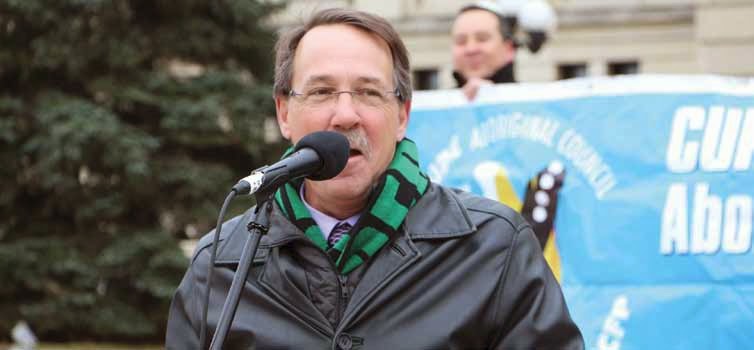 “The decision by the Supreme Court to grant every worker in
Canada a constitutional right to strike is a profound victory for our
movement,” said Hubich, “the Court also delivered a strong message to conservative
governments everywhere: your rigid ideology does not trump workers’ rights,” he
added.
The Public Services Essential Services Act (Bill 5) was
introduced by the newly-elected Saskatchewan Party government in 2007. As soon
as it was introduced, workers, their unions, lawyers, and academics all said
the Bill was overreaching, unnecessary, and probably illegal. The Saskatchewan
Party, though, continued to only listen to their corporate friends instead of
Saskatchewan families. As a result, a long Charter Challenge was launched by
the SFL and its affiliates against Bill 5 to protect working families.
Despite the long and expensive court process, workers and
their unions were gracious in their victory – extending an invitation to the
Saskatchewan Party government to work together.
“We know that a work stoppage is always the last resort, and
unions always prefer a negotiated agreement that is good for both sides,” said
Hubich, “our victory does not change any of that, and we want to work with the
provincial government to develop labour laws that are fair, balanced, and
respect the rights of workers,” he added.
However, just a few days after the SCC ruling, Brad Wall
floated the option of using the notwithstanding clause so that he and his
government could continue violating Charter rights.
“This is a time for reconciliation and leadership, not a
time for the premier to stomp his feet and threaten to deny Saskatchewan
families their Charter rights,” said Hubich, “workers and their unions continue
to offer our cooperation to create good public policy, and we hope the premier
will come to the table in good faith,” he added.
Saturday, 7 April 2012
Court Decision Upholds Working People's Rights

He also found that the right to strike is protected by international law, and that governments are bound by international law when assessing the constitutionality of our laws under the Charter. Download Justice Ball's decision here....
As a result of these findings, he ruled that the Sask. Party government’s “essential services” legislation (also known as Bill 5), violates our fundamental freedoms and human rights. He said the law, in its entirety, is unconstitutional.

The Judge said that when a law violates the Charter, if the government has failed in its duty to consult prior to passing the law, the law must be struck down. Just like the United Nations’ International Labour Organization (ILO) warned the Saskatchewan government, they must consult with citizens before introducing legislation that affects Charter rights.
Justice Ball even paid attention to the role of government as employer. He said that governments cannot use their sovereign power to legislate in a manner that eliminates the obligation to respect their employees’ collective bargaining rights.
What happens now?
The Judge ruled that the invalidity of the old law is suspended for 12 months, to give the government time to fix it if possible.
The government is appealing the Judge’s ruling that freedom of association includes the right to strike, in the hopes that, if they win, Bill 5 will stay in force. At the Saskatchewan Court of Appeal, the unions will defend the right to strike finding, and will cross-appeal on the unconstitutionality of Bill 6 (the 2008 changes to The Trade Union Act).
What about Bill 6?
The Judge did not agree with our argument that the changes to The Trade Union Act violated workers’ fundamental freedoms under the Charter. He did not, however, dispute our facts about the number of union certifications decreasing since the passing of the laws. Regarding employer communication, he says “even a reasonably courageous employee can be cowed by employer statements that directly or implicitly threaten negative consequences if the wishes of the employer are opposed.”
What kind of input will labour have into any new essential services law?
Minister Don Morgan asked us for written feedback, with a deadline of two weeks. Working people’s organizations (which already submitted feedback on Bill 5 and 6 to the government when it was introduced, and also to the court in its written and oral arguments) have asked for face-to-face meetings to discuss what kind of consultation would comply with Judge Ball’s decision.
What are the remedies?
The Judge has agreed to hear submissions on remedies for the violation of working people’s rights.
Five little-known facts about the Bills 5 and 6 Charter challenge
1. Non-affiliated unions who joined in solidarity with the SFL et al: 3 (Health Sciences Association of Saskatchewan, University of Regina Faculty Association, and Teamsters local 395.)
2. Number of lawyers who participated in the trial (from both sides): 19
3. Total days of argument: 12
4. Number of pages filed with the Court: approximately 15,000
5. Employers who intervened in the case (SAHO, the Saskatoon Regional Health Authority, SaskPower, SaskEnergy, the University of Regina, the University of Saskatchewan, City of Regina, City of Saskatoon, SUMA and SARM) argued that management should have the final say in who can strike and who cannot.
Quotable Quotes
“I am satisfied that the right to strike is a fundamental freedom protected by s.2(d) of the Charter along with the interdependent rights to organize and to bargain collectively. That conclusion is grounded in Canada’s labour history, recent Supreme Court of Canada jurisprudence and labour relations realities. It is also supported by international instruments which Canada has undertaken to uphold.”
— Justice Dennis Ball, Saskatchewan Court of Queen’s Bench, February 2012
“The ultimate truth of free collective bargaining is that it can only operate effectively, in market terms, if it is backed up by the threat of economic sanction.”
— Justice Ball, quoting Rayner
“...the evidence clearly established that substantive consultations with respect to the PSES Act took place only between the Government and employer groups. It also establishes that although the largest public sector Unions made every effort to meet with the Government representatives in order to have meaningful input into the legislation, their efforts were unsuccessful. Any consultation with the Unions about the PSES Act was superficial at best.”
“It is enough to say that no other essential services legislation in Canada comes close to prohibiting the right to strike as broadly, and as significantly, as the PSES Act. No other essential services legislation is as devoid of access to independent, effective dispute resolution processes...”
Download a PDF Version of the SFL Newsletter here....
Tuesday, 17 January 2012
Net Benefit
"Rio Tinto and Caterpillar Electro Motive are newly minted Canadian corporate citizens who have locked their workers out to freeze and starve. These corporate muggers were allowed into Canada and encouraged in their anti Canadianism by the Harper Junta. It's going to be a cold winter and a hot summer in Canada..."
Wednesday, 29 June 2011
Join Us For the Unveiling of a Headstone In Memory of Nick Schaack

Join Us For the Unveiling of a Headstone In Memory of Nick Schaack
What: Unveiling of a commemorative headstone for Nick Schaack, who died as a result of his participation in the Regina Riot, July 1st, 1935, struggling for economic security on behalf of the people of Saskatchewan and all Canadians.
When: Friday, July 1st, 2011 at 11:00am.
Where: We will meet at the Regina Cemetery (the corner of 4th Avenue and Broad Street) for the unveiling ceremony and then travel to the office of the Saskatchewan Union of Nurses (2330 2nd Avenue, Regina) for a FREE BBQ!
Who: Everyone is welcome!
Thursday, 16 June 2011
Tuesday, 24 May 2011

Friday, 21 January 2011
Tuesday, 18 January 2011
Sunday, 2 January 2011
Sunday, 23 August 2009
What it takes to be number one - The Real News
"What it takes to be number one
The strike against Vale-Inco in Sudbury heats up as company threatens to use non-union labor
The nickel miner strike in Sudbury, Canada is about to enter its seventh week, and there is no sign that the company, Vale, is willing to compromise on its demands for concessions. This despite the fact that the demand for nickel has surged causing the price to rise and Vale to default on at least one contract. Worker's argue that the mine is hugely profitable, sighting $4B in profit made in Sudbury alone over the past two years, but as Industry Analyst Marin Kotusa explains, being profitable is just not enough. "You have to be number one in all sectors," he says, referring to the requirements for victory in the global mining game, in which the winners are the ones who integrate all facets of the supply chain, not just mining, into their business. This requires extracting as much profit as possible in order to finance the necessary expansion into other sectors, lest be gobbled up by one's competitors. The union however, believes that the federal government of Canada ought to protect its people against such threats, and that work can be done to unify unions around the world to even the playing field." - For more information visit The Real News Network.
Wednesday, 17 June 2009
Wednesday, 10 June 2009
Unions and international standards
There's a very interesting article on the StraightGoods website by Dr. Roy J. Adams about Canadian labour laws in the context of international standards. It can be found by clicking here.... and is reproduced below:
Unions and international standards
Supreme Court constitutionalized unions but Canadian laws have yet to follow.
Dateline: Monday, June 08, 2009
by Roy J Adams
Two years after the landmark Supreme Court decision that constitutionalized the right to organize and to bargain collectively, not much has changed. Contrary to what might be expected, neither federal nor provincial governments have moved to bring their legislation into line with the international standards against which the SCC judged them.
Instead, governments have put forth legislation that seems likely to be found contrary to the decision. As well, one recent case is almost certainly contrary to international standards and another, if upheld, will thoroughly shake confidence in long standing Canadian approaches to labour law.
Some 70 percent of Canadian workers have no effective say in their conditions of work, due to current laws.
Until two years ago collective bargaining in Canada was, at best, a statutory right, given or taken away by current laws. Its status would vary with the change of political tides. Then came the 2007 BC Health Services case, where the Supreme Court lavishly praised the capacity of collective bargaining to strengthen the Charter values of freedom, democracy, equality, autonomy and dignity.
Although the Supreme Court did not pronounce on the right to strike in its 2007 decision, it did say that Canadian workers should be able to rely on standards that Canada has committed to in the international arena. The right to strike is clearly considered in international human rights law to be an essential element of the right to bargain collectively.
However, to the best of my knowledge, no Canadian government has loosened strike restrictions that offend international law. Instead, in apparent defiance of the Supreme Court, two Canadian governments have gone in the opposite direction.
During the summer and fall of 2007 a minority Nova Scotia Tory government threatened legislation extending the ban on health care worker strikes. The initiative proved to be so unpopular that the government never brought forth the promised legislation, so its constitutionality was not tested.
In Saskatchewan, however, the right-leaning Saskatchewan Party did pass legislation in 2008 restricting public sector workers right to strike. The law has been challenged by the Saskatchewan Federation of Labour and is now before the courts.
In Canada, our well-established approach to bargaining structure (which union bargains for which workers with which employer) has been to legislate it. Typically an established union applies to a labour relations board to become the exclusive agent of a coherent group of employees such as all production workers in a factory or all clerks in a retail store. When the labour board issues an order certifying the union, a bargaining unit is created.
Internationally, however, the standards call for unions and employers to negotiate their own structure. Indeed, one of the pillars of international law with respect to the right to organize is that any group of workers may form a union or association and, through it, negotiate with relevant employers.
International standards say that employers have a responsibility to recognize and bargain in good faith with such unions even if those unions have not signed up the majority of the relevant workers.
This approach opens up the possibility that employers may encourage independent non-statutory unions in hopes that they will be weaker than certified unions operating with the support of government legislation.
Fearing this effect, many established unions are not keen on the non-statutory option. But neither are many employers, because they may find themselves faced with incompatible demands from several minority unions.
In a 2008 case concerning agricultural workers, the Ontario Court of Appeal issued a decision ordering the Ontario government to institute certification legislation for agricultural workers that would, contrary to international law, eradicate the possibility of minority unionism.
That decision produced a remarkable reaction which indicates how little international standards are understood in Canada and how strong the current patterns of behaviour are.
Apparently unaware of the courts insult to international human rights standards, the United Food and Commercial Workers — one of four unions actively promoting the notion of labour rights as human rights — was delighted with the decision because it would allow the union to use its traditional organizing techniques to target factory farms. In response to the decision, the corporate farm lobby pressured the Ontario government to appeal the decision. And that's what it did.
So here we have an employer lobby pushing for a decision consistent with international standards, versus a union know for championing human rights that is, in this case, cheering a decision that offends human rights.
Another instance that demonstrates the clash between legislated and non-statutory certification occurred in Québec.
There, the government recently decided that there were too many bargaining units in the public sector and reorganized and simplified them by legislation. Unions negatively affected by this initiative appealed the employers actions, claiming an infringement of their freedom of association. A Quebec Court agreed with them and told the government to back off.
If the Quebec decision stands, governments may have to rethink their approach to legislating bargaining structure — but probably not too much. Majoritarian certification is acceptable under international standards, so long as workers and their employers are able to organize and bargain in other formats if they choose to do so.
Although not forbidden, historically non-statutory bargaining arrangements have been given essentially no legal support in Canada. But even with some legal backing, non-statutory bargaining may not catch on because of the psychological and cultural commitment that our industrial relations actors have to our current procedures.
For example, both international standards and the language used by the Supreme Court in recent decisions indicate that public sector employers have a direct constitutional responsibility to recognize and bargain with unions of their own employees regardless of their employees status under labour law.
In Ontario, college part-timers, excluded from the relevant legislation, formed an association and began to push to be recognized. But instead of seeking to negotiate a tailor-made procedure as international law says they are entitled to, they instead sought to be included under legislation that embodied traditional Canadian principles of majoritarianism, legislatively imposed structure and exclusive representation.
As things now stand, some 70 percent of Canadian workers have no effective say in the establishment of their conditions of work. For those workers our traditional approach to labour legislation is not working. The best chance that they have of acquiring the democracy, freedom, equality, autonomy and dignity enhancing benefits of collective bargaining is full acceptance by all concerned of both the spirit and letter of international human rights law. But cultural patterns, once firmly established, have a way of persisting. It remains to be seen whether activist courts can break those patterns.
Wednesday, 3 June 2009
Monday, 30 March 2009
Noam Chomsky on the economy and democracy Pt2 - The Real News
Noam Chomsky: The best way to move forward is support unionization
Wednesday, 15 October 2008
Steelworker Strike at Potash Corporation of Saskatchewan drags on
 Now that the totally unnecessary election which effectively wasted about $300 million worth of taxpayers hard earned cash is over - we can get our focus back on the bargaining disputes currently ongoing at various Saskatchewan workplaces.
One such dispute is the strike at three mine sites of the Potash Corporation of Saskatchewan where close to 500 United Steelworker members have been on strike for a fair collective agreement since August 7, 2008.
You can follow the dispute at a couple web-sites:
At a local steelworker web-site set up at: http://www.potashworkers.com/
and at the USW Canada national web-site.
As well, check out the video below of Saskatchewan Steelworkers who recently participated in a protest in London, England were the PCS was holding a London Analysts Meeting:
Sunday, 28 September 2008
Striking Saskatchewan Potash Workers create web site to explain dispute

 United Steelworker (USW) members employed by the Potash Corporation of Saskatchewan who have been on the picket line since August 7, 2008 have created a web site to share information about the ongoing dispute.
Check out the site at: www.potashworkers.com
Tuesday, 9 September 2008
The Definition of SOLIDARITY!
 In what can only be described as a shining example of Solidarity, locked out members of Grain Services Union (GSU) who have been in a fight for survival against the Regina, Saskatchewan based corporate bully and grain company "Viterra, Inc." made a donation to the strike fund of the United Steelworkers (USW) on strike against Saskatchewan based global potash giant (and also corporate bully) "Potash Corporation of Saskatchewan".
Reproduced is a letter I received on September 8, 2008 from GSU General Secretary, Hugh Wagner:
Brother Larry Hubich and
Delegates to the Annual SFL OH&S Conference
Sisters and Brothers,
Re: Grain Services Union picket line
Your attendance today at our picket line at Viterra head office together with the solidarity and enthusiasm you brought have done so much to bolster the morale of GSU members who have been on the line since July 7.
Words alone can't express how you have touched the hearts and raised the spirits of GSU members who are fighting the good fight. Thank you from the bottom of all of our hearts for your solidarity.
As a token of our appreciation, please be advised that GSU is making an intial donation of $1,000 to the strike fund of our sisters and brothers who are on strike at the Potash Corporation of Saskatchewan. In addition, we are sending five GSU t-shirts for you to raffle at your conference in aid of any cause that you choose.
Solidarity,
On Behalf of the Women and Men of GSU
Hugh J. Wagner
General Secretary
You can download a PDF version of the above letter by clicking here.....
Viterra management and supporters resort to assault and violence against GSU picketers


Two recent issues of the Grain Services Union strike bulletin: The GSU Review reveals a disturbing and unacceptable trend. Viterra management and their supporters have resorted to violent assaults and physical attacks against GSU members who are engaged in lawful picket activity.
Click on the above images to download copies of both the September 5 issue, and the September 8 issue.
Hey Viterra - it's time to call off the goons!
Wednesday, 27 August 2008
SFL Labour Reporter - September 2008 Issue

The September 2008 issue of the SFL Labour Reporter is now available on line.
Click here to download in PDF Format.
Subscribe to:
Posts (Atom)